

Dutch-process cocoa
Dark confectionery cocoa, 21% fat class. Red-brown colour, creamy taste, no added sugar.
- Price
- 500 g / 270 CZK
- How to order
- Contact · +420 728 466 141 · juzlj@seznam.cz
The listed price is for the goods only. Tracked delivery, packaging and insurance are extra.

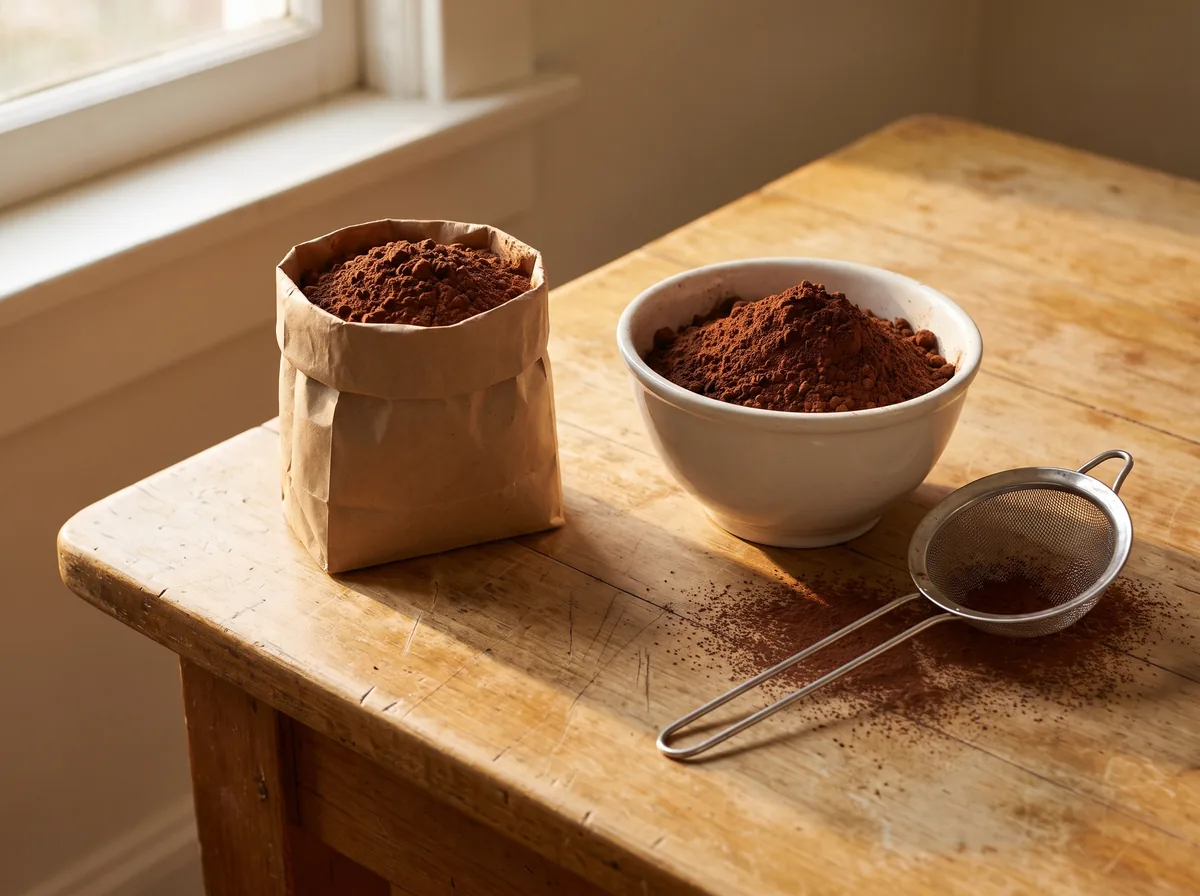
Our dark confectionery cocoa is Dutch-process — an alkalised powder from Theobroma cacao beans, 21% fat class. Full cocoa body, a creamy chocolate taste and a deep red-brown colour that holds both dry and in the finished recipe.
Where the cocoa comes from
The beans dry slowly in the sun in Central West Africa. They ferment naturally in banana leaves — that is how the deep chocolate flavour is born, which we then soften by alkalisation into Dutch-process cocoa.
Fat 20–22%: why the range matters
We keep cocoa butter at 20.0–22.0%. That is more fat than in lean supermarket cocoas (often 10–12%). More butter means more moisture in the dough, a rounder mouthfeel and a fuller chocolate impression — the 21% class pastry cooks look for.
No added sugar
We add no sugar. The only sugars you will find — 0.9 g per 100 g — occur naturally in the cocoa bean.
Sensory profile
Full-bodied cocoa intensity, a creamy chocolate flavour and roasted notes. The colour is a deep red-brown — in the powder and in the finished cake.
- Intensity92
- Creaminess88
- Roast78
- Colour94
- Softness86
Where it belongs
Baking
Gingerbread, cakes and doughs that should stay richly cocoa-coloured after baking.
Drinks
Hot cocoa and milkshakes — it holds colour and a creamy taste in milk.
Creams
Fillings, creams and light desserts when you want chocolate without sugar in the powder.
Dusting
Finished slices, roulades and biscuit desserts — a dark, fine dust that does not clump.
With vanilla pudding
Stir it into our vanilla pudding: you get a chocolate cream from one mix.
Porridge and cereals
Breakfast bowls that should taste of chocolate, not of a bitter powder.
What is in the cocoa
Per 100 g: plenty of fibre and protein, naturally little sugar, no added sugar.
Also magnesium 490 mg, potassium 4,400 mg and iron 31 mg per 100 g.
Indicative values per 100 g under EU Regulation 1169/2011. You use cocoa by the spoon — a serving is a fraction of the table.
Technical facts
- Cocoa butter20.0–22.0%
- pH (10% solution)7.8–8.2
- Finenessmin. 99.5% through 75 µm
- Moisturemax. 5.0%
- Shellmax. 1.75%
- EU allergensnone of the 14
- Gluten< 20 ppm
- Dietvegan, vegetarian
Frequently asked questions
Why is your cocoa cheaper than other brands?
We are a family business and we run production ourselves, on site. There is no middleman between us and you. We keep packaging simple, buy in bulk and run an efficient workshop. Every saving we make is passed on to you.
Why does the price of cocoa move so often?
Cocoa is a traded commodity. The price reacts to weather, demand, politics and new laws. For example, the EU sets limits on how much heavy metal cocoa may contain. That makes low-heavy-metal cocoa rarer and more in demand — and so more expensive.
What is cocoa mass?
Cocoa mass is the pure, solid paste made entirely from the inside of the cocoa bean. Nothing else is in it.
Cocoa mass, cocoa liquor, unsweetened chocolate — what is the difference?
None. Three names for the same thing. “Liquor” only means the paste flows when warm — there is no alcohol in it.
Is any shell, pod or pulp added to your cocoa?
No. Our powder is made only from the cocoa mass — the inside of the bean. Some brands grind down the cocoa pod, the shell (husk) and the pulp and blend them into the expensive cocoa mass to add weight. You will see packs saying “made from 100% cocoa pod”. The pod is not the part you eat — it is the case the beans are stripped out of.
How much cocoa butter (fat) is in it?
20–22%. Under EU law a powder must contain at least 20% cocoa butter to be called cocoa powder; below that it must be labelled “fat-reduced cocoa”. Ours sits at the full-fat end. The cocoa butter gives a smooth mouthfeel, deeper colour and a rounder chocolate taste.
Natural, alkalised (Dutch) and raw cocoa — what is the difference?
Natural — not treated with alkali, pH 5–6. Sharper, slightly sour, fruity, lighter brown. Alkalised (also called Dutch) — treated with a small amount of alkaline salt. Milder, rounder, less sour, darker, mixes into liquid more easily. Raw — from beans not roasted, or only lightly roasted; strong, bitter, grassy. Ours is alkalised at a medium level (pH 7.8–8.2): an intense red-brown colour that does not fade, full cocoa body, creamy chocolate flavour and roasted notes.
What is alkalising, and what do you use?
Treating the cocoa with an alkaline salt to soften the acidity and deepen the colour. We use only natural salts, sourced mainly from Germany and Italy. Nothing else is added.
What nutrients does alkalised cocoa powder have?
It keeps the minerals and fibre naturally in the bean — magnesium, iron, potassium, phosphorus and copper — plus the cocoa butter. Alkalising does lower the level of flavanols, the antioxidant compounds, compared with natural cocoa. Exact amounts are on the nutrition panel on the pack.
Where does your cocoa come from?
Central-west Africa. The soil there carries very few volcanic deposits, one reason the cocoa is naturally low in heavy metals. We buy premium grade.
What does “fermented in banana leaves” mean, and why does it matter?
After the pods are opened, the wet beans are piled up at source and covered with banana leaves for about five days. The waxy leaves hold the heat in and the beans ferment naturally. Fermentation is what creates chocolate flavour: it reduces bitterness and builds the compounds that become chocolate taste during roasting. Beans dried without fermenting taste bitter and flat. The alternative is large wooden boxes — easier to standardise at industrial scale, but a different, often sharper profile.
Why slow, natural sun-drying?
After fermenting, the beans go from around 60% moisture down to about 7%. Sun-drying does this slowly, letting the sharp acids escape. Drying too fast leaves the beans sour and hardens the outside. Machine dryers are faster, but where hot air and smoke touch the beans directly they can pick up a smoky taste. Ours are laid out and dried slowly under the African sun.
Can I use it for ice cream?
Yes. The high cocoa butter content suits ice cream: a strong cocoa flavour, a smooth texture and a deep colour that does not fade. It works in homemade ice cream too.
Does cocoa powder contain heavy metals?
All cocoa does — the plant takes up trace metals from the soil. How much depends on where it grows and how carefully it is sourced. Cocoa from South America often runs higher, because the soil there holds more volcanic deposits. Ours comes from central-west Africa, where volcanic deposits are very low. We source premium cocoa within the EU limits set by Regulation (EU) 2023/915.
Do you add sugar?
No. Added sugar is 0 g. Naturally occurring sugars from the bean are 0.9 g per 100 g.
Is it gluten-free and allergen-free?
Yes. It contains none of the 14 EU allergens. Gluten is below 20 ppm. It is vegan and vegetarian — no ingredients of animal origin.
How should I store it?
Dry, away from strong odours, ideally at 15–20 °C with humidity under 50%.
Is the cocoa the same as pudding?
No. Cocoa is a 500 g Dutch-process powder at 270 CZK. Pudding is a separate vanilla mix.
Does 270 CZK include delivery?
No. The price applies at pick-up. Tracked delivery, packaging and insurance are extra.